
Indigenous natural gas from the Malampaya field is once again supplying the 1,200-megawatt Ilijan Power Plant, restoring a key link in the country’s gas-to-power infrastructure and strengthening the role of domestic gas in supporting energy security and electricity affordability.
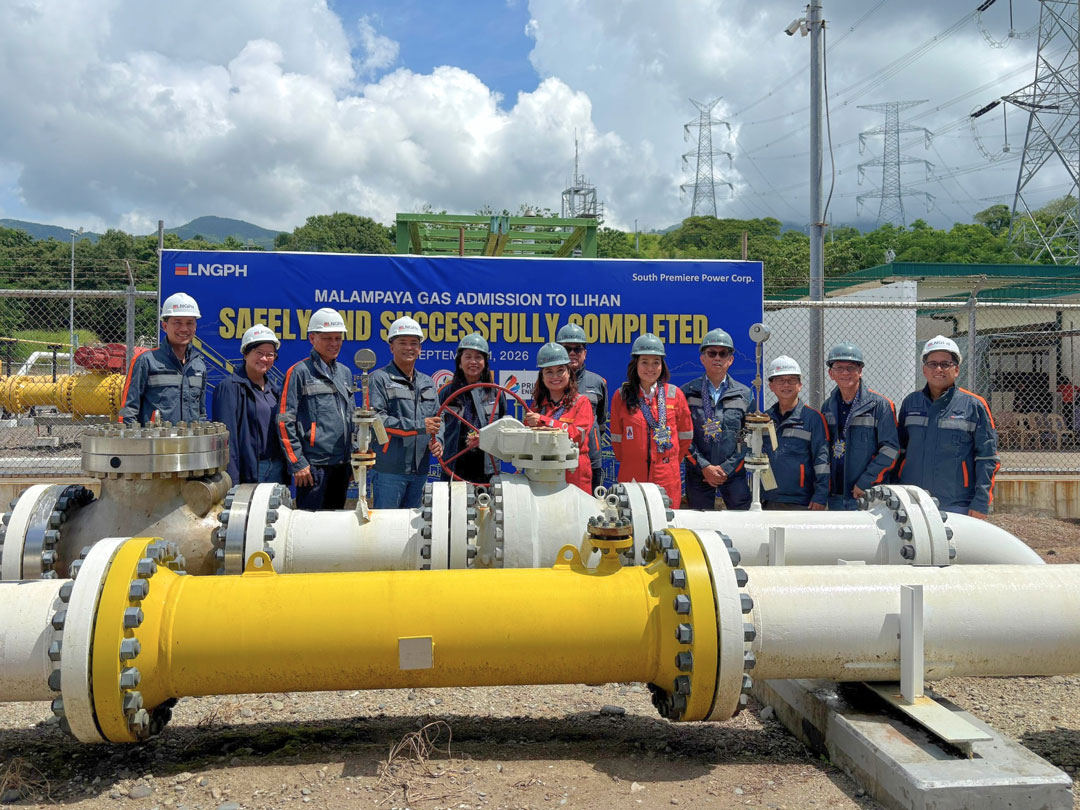
Department of Energy Secretary Sharon Garin, Prime Energy President and CEO Donnabel Kuizon Cruz, and LNGPH President and CEO Yari Miralao led the ceremonial admission of Malampaya gas into Ilijan on Sept. 24, alongside representatives from the DOE, PNOC Exploration Corp. (PNOC-EC), Power Sector Assets and Liabilities Management Corp. (PSALM) and the Service Contract 38 Consortium.
Under an Interim Natural Gas Supply Arrangement, Prime Energy, the operator of Service Contract 38, is supplying Malampaya gas to South Premiere Power Corp. (SPPC) for the Ilijan power plant.
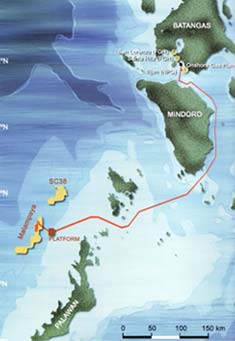
The return of indigenous gas to Ilijan was made possible through the collaborative efforts of Prime Energy and SPPC, as well as PNOC-EC and PSALM, to restore the Tabangao-Ilijan Pipeline. The companies worked together to ensure that the infrastructure was restored and brought back into service with safety as a priority.
Ilijan was among the facilities that established the Philippines’ first indigenous gas-to-power value chain following the development of the Malampaya field. Its original gas supply arrangement dates back to 1997, before Malampaya began commercial production in 2001.
“What we are celebrating today is not just the admission of Malampaya gas and the beginning of a new gas supply arrangement,” Cruz said. “It is also the continued use of critical energy infrastructure that was built decades ago and maintained to serve the country’s evolving energy needs.”
The current arrangement covers a six-month period from Sept. 1, 2026, to Feb. 25, 2027.
The return of Malampaya gas also demonstrates the value of indigenous fuel in reducing exposure to international energy price volatility. The use of indigenous Malampaya gas at Ilijan is expected to contribute about 36 centavos per kilowatt-hour in lower generation charges beginning September 1, providing potential relief to electricity consumers.
Over the past decade, indigenous gas has maintained a price advantage over imported spot LNG, with the difference reaching more than $4 per million British thermal units (mmBtu) at various points. Using domestic gas can help power generators manage exposure to fluctuations in international fuel markets.
Beyond price, indigenous gas contributes to energy security by providing a domestic source of fuel for power generation. It complements imported LNG and other energy sources while helping diversify the country’s fuel supply.
Malampaya has also generated significant economic value for the country. Since production began in 2001, Service Contract 38 has contributed more than $14 billion in revenues to the Philippine government.
The six-month interim arrangement provides a platform for continued collaboration between Prime Energy and SPPC as the companies explore opportunities for a longer-term gas supply relationship.
At the same time, Prime Energy continues to invest in extending the productive life of the Malampaya field and developing additional indigenous resources. Malampaya Phase 4 is targeted to deliver additional domestic gas in the fourth quarter of 2026, supporting the country’s efforts to strengthen indigenous energy supply.
“Price stability, affordability, reliability and energy security — these are among the benefits of using our own Malampaya gas,” Cruz said. “Today, we celebrate this new chapter and our shared commitment to a more secure, resilient and affordable energy future for the Filipino people.”