
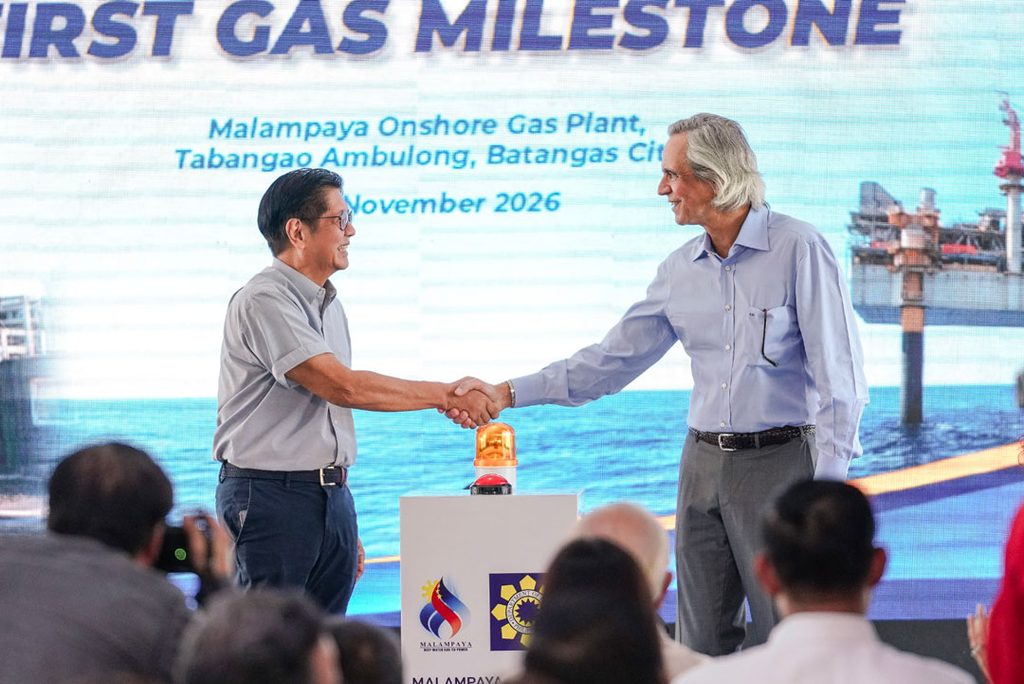
POWERING ENERGY SECURITY: President Ferdinand R. Marcos Jr. (left) and Prime Infra Chairman Enrique K. Razon Jr. (right) mark the ceremonial First Gas flow of Malampaya Phase 4 (MP4) at the Malampaya Onshore Gas Plant in Batangas City on November 5. The project integrates two new deepwater wells to help secure the country’s grid stability.
The Malampaya Phase 4 (MP4) project has achieved its First Gas milestone, successfully bringing natural gas from the Malampaya East-1 and Camago-3 wells into the existing Malampaya production system. The achievement marks a significant milestone for the Malampaya consortium and reinforces the project’s role in sustaining the Philippines’ indigenous natural gas supply.
President Ferdinand R. Marcos Jr., together with Department of Energy (DOE) officials and SC 38 joint venture partners, witnessed the ceremonial first flow of gas at the Malampaya Onshore Gas Plant in Batangas City on November 5. The achievement marks a significant step in sustaining the Philippines’ indigenous natural gas supply and extending the productive life of the Malampaya field.
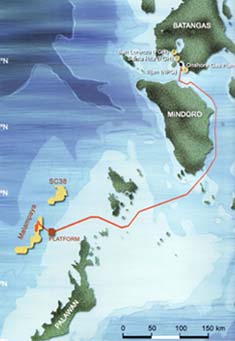
“From offshore Palawan, this indigenous natural gas will flow through the Malampaya gas transmission infrastructure to Batangas, and ultimately to the gas-fired power plants serving the Luzon grid,” President Marcos said.
He underscored the project’s direct relevance to Filipino households, emphasizing: “Sariling gas. Mas maaasahang kuryente. Mas matatag na enerhiya para sa ating bansa.” (What does this mean for every Filipino family? It means we have our own gas, more reliable electricity, and more resilient energy for our country.)
The President also highlighted the importance of maximizing indigenous natural gas to help manage electricity costs, noting that greater use of Malampaya gas “could contribute to more competitive power rates because we are relying less on imported energy sources that are subject to volatile international energy prices.”
Prime Infra Chairman Enrique K. Razon Jr. highlighted Malampaya’s enduring contribution to national development and the importance of continued investment in its resources.
“For 25 years, Malampaya has demonstrated the value of developing our own energy resources. It has powered millions of Filipino households and businesses, supported economic growth, and generated more than US$14 billion in government revenues. But Malampaya’s resources are finite. Sustaining production requires continued investment and the technical expertise to develop reserves that are increasingly challenging to access. That is what Malampaya Phase 4 represents,” Razon said.
With an investment of close to a billion dollars, MP4 involved drilling two deepwater wells and installing subsea infrastructure to connect them to the existing Malampaya production platform. The project added an estimated 222 billion cubic feet (Bcf) of recoverable natural gas reserves, capable of generating approximately 31.46 billion kilowatt-hours of electricity—enough to power 13.11 million Filipino households for one year.
MP4 was completed in 27 months after final investment decision, approximately five months ahead of its original schedule, and five months ahead of the industry benchmark. This achievement reflects the strong coordination across the project, particularly given the complexity of deepwater development, which involved multiple contractors and suppliers and required the mobilization of specialized equipment, manufactured components and technical experts from around the world.
MP4 also marked the Philippines’ first offshore drilling campaign in more than a decade. Its execution drew on an international supply chain spanning 17 countries, including Germany, the United Kingdom, Norway, the Netherlands, the United States, Japan, South Korea, Australia, Singapore, Malaysia and the Philippines.
The global network supported the fabrication, refurbishment and delivery of critical subsea components and equipment, including umbilicals, valves, subsea systems, cables, generators, pipelines and wellhead equipment. Philippine-based fabrication and manufacturing capabilities also contributed to the project, demonstrating the role of local industry in supporting complex offshore energy developments.
President Marcos recognized the contribution of the private sector and Filipino talent in delivering the project, describing Malampaya as proof of what can be achieved through collaboration among government, industry and Filipino professionals.
“You have shown us what Filipinos are capable of. You have demonstrated once again that Filipinos possess the competence and determination to deliver projects of national importance,” he said.
Based on initial well-test results, the two wells will extend Malampaya’s productive life by approximately six years, depending on future gas offtake. Following first gas, the integration and ramp-up of the new wells into the existing production system will continue over the coming months. Sustainable production levels will be established as operating data becomes available.
Malampaya natural gas currently supplies gas-fired power plants in Batangas that serve the Luzon grid. Additional indigenous gas from the new wells is expected to help sustain domestic fuel supply for the power generation sector and support the country’s growing electricity requirements.
A greater supply of indigenous natural gas can also help reduce the power sector’s exposure to fluctuations in international fuel markets. Over the past decade, domestic Malampaya gas has maintained a price advantage over imported spot liquefied natural gas (LNG), with the difference exceeding US$4 per million British thermal units (mmBtu) at various points. This price advantage can help power generators manage fuel costs, although electricity rates remain subject to several factors, including generation costs, plant operations, market conditions and applicable supply agreements.
The continued use of Malampaya gas at the SPPC power plant in Ilijan under an interim gas supply arrangement is also expected to contribute to an overall reduction in generation charges of gas-fired power plants, estimated to be approximately ₱0.36 per kilowatt-hour beginning September 1. The benefit underscores the value of access to domestic natural gas alongside imported LNG and other energy sources in diversifying the country’s fuel mix.
Since commercial operations began in 2001, the Malampaya Deep Water Gas-to-Power Project has supplied natural gas to power plants in Batangas that support approximately one-fifth of Luzon’s electricity requirements. Its continued development will help sustain this contribution as demand for reliable and affordable electricity grows.
Beyond its contribution to the country’s energy supply, Malampaya has generated substantial economic value for the Philippines. Since production began in 2001, SC 38 has contributed more than US$14 billion in revenues to the Philippine government.
With MP4 now delivering gas from two new wells, Prime Energy continues to build on the Malampaya field’s legacy while pursuing further opportunities to develop the country’s indigenous energy resources.
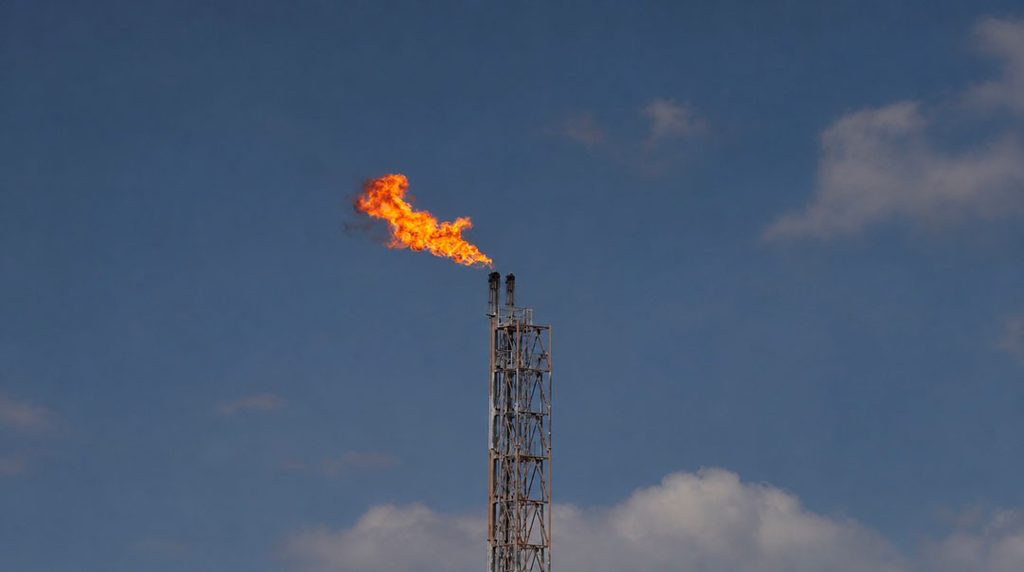
A ceremonial flare lights up at the Malampaya Onshore Gas Plant, symbolizing the successful flow from Malampaya Phase 4. The milestone unlocks an estimated 222 billion cubic feet of natural gas reserves to power millions of Filipino homes.